
Title I
The purpose of Title 1 is to:
- Help students to achieve proficiency on state academic standards (primarily in Reading/Language Arts and Mathematics).
- Build teacher capacity through quality professional development.
- Enhance parents’ abilities to help their children succeed through quality parental involvement activities.
A Title I school receives Title I funds under the following guidelines:
- The percent of low-income children in a given school must equal or exceed district average poverty.
- To be eligible for Title I funds, a charter school must have at least 10 low income children.
- In Utah, low income students are typically identified through the free/reduced lunch application.
A Comprehensive Schoolwide School
- has at least 40% poverty.
- Creates a plan that integrates a comprehensive needs assessment and schoolwide reform strategies (typically 1 year to develop plan).
- Has Flexibility in use of funds.
- Maintains schoolwide mission and goals that shape school decisions and helps all students achieve high standards.
- Title I schools are to implement research-based instructional strategies.
- Consider extended learning time options to help students needing additional help:Before and after school programsSummer school programsIntersession or Saturday school programsOther extended-day programs
- Instruction delivered by highly qualified staff.
- Timely identification of learning needs through assessment.
- Targeted interventions for those students who need additional instructional help.
- Annual review of school academic progress.
.
Title 1 funds are used for:
- Implementing school goals and objectives.
- Supporting individual student achievement.
- Title 1 Funds should avoid supplanting programs created by other State and Federal funding sources.
Effective uses of Title 1 Funds include:
- Personnel
- Textbooks and Supplies
- Extended day/year program
- Early childhood program
- Full and/or extended day kindergarten
- Counseling
- Accelerated, high quality curriculum that enables disadvantaged students to achieve challenging standards
Check out the Volunteer page for more information about volunteering. Contact the building secretaries if you have any questions or would like to help out: lrocha@ogdenprep.org (
The following are documents important for parents.
Parent Compact
8.03.TPL.1 Parent and Family Engagement Compact Form (2)
Parent Involvement Policy
8.03.POL Parent and Family Engagement PolicyClassroom Volunteer Policies

Volunteer Reporting
Click on the image to go to the volunteer reporting website to report your volunteer hours:

Highly Qualified Staff
At Ogden Preparatory Academy we are very proud of our teachers and feel they are prepared to give your child a high-quality education. As a Title I school, we must meet federal rules related to teacher qualifications as defined in No Child Left Behind. These rules allow you to learn more about your child’s teachers’ training and credentials. We are happy to provide this information to you. At any time, you may ask about your child’s teachers’ or paraprofessionals’ qualifications and degrees. Our staff is committed to helping your child develop the academic knowledge and critical thinking he/she needs to succeed in school and beyond. That commitment includes making sure that all of our teachers and paraprofessionals are highly skilled. If you have any questions about your child’s assignment to a teacher or paraprofessional, please contact the principal of your child’s school:
Kacey Kennington – Elementary Principal
Shevon Lopez – Jr. High Principal
Teryl Young- ECC Principal
FERPA
FERPA stands for Family Educational Rights and Privacy Act. 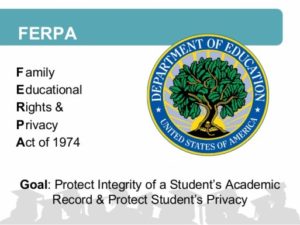
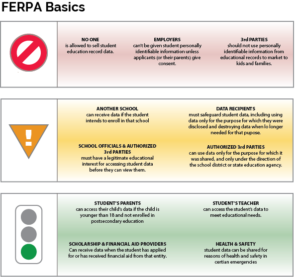
The Family Educational Rights and Privacy Act (FERPA) is a federal law that affords parents
- the right to have access to their children’s education records
- the right to seek to have the records amended
- and the right to have some control over the disclosure of personally identifiable information from the education records.
When a student turns 18 years old, or enters a postsecondary institution at any age, the rights under FERPA transfer from the parents to the student.
For more information go to: https://studentprivacy.ed.gov/faq/what-ferpa
Website Resources:
Privacy
Data Quality Campaign
https://dataqualitycampaign.org/
FERPA Index
https://www2.ed.gov/policy/gen/guid/fpco/ferpa/index.html
IDEA
IDEA is a federal law that requires schools to provide a free and appropriate education for students with disabilities.
The first stated purpose of the Individuals with Disabilities Education Improvement Act (IDEA) of 2004 is “to ensure that all students with disabilities have available to them a free appropriate public education that emphasizes special education and related services designed to meet their unique needs and prepare them for further education, employment, and independent living”


Website Resources:
Home Page: IDEA
About IDEA
https://sites.ed.gov/idea/about-idea/
Utah Special Education Services
https://www.schools.utah.gov/specialeducation/resources/lawsrulesregulations
Understood: For Learning and Attention Issues
National Center for Learning Disabilities